
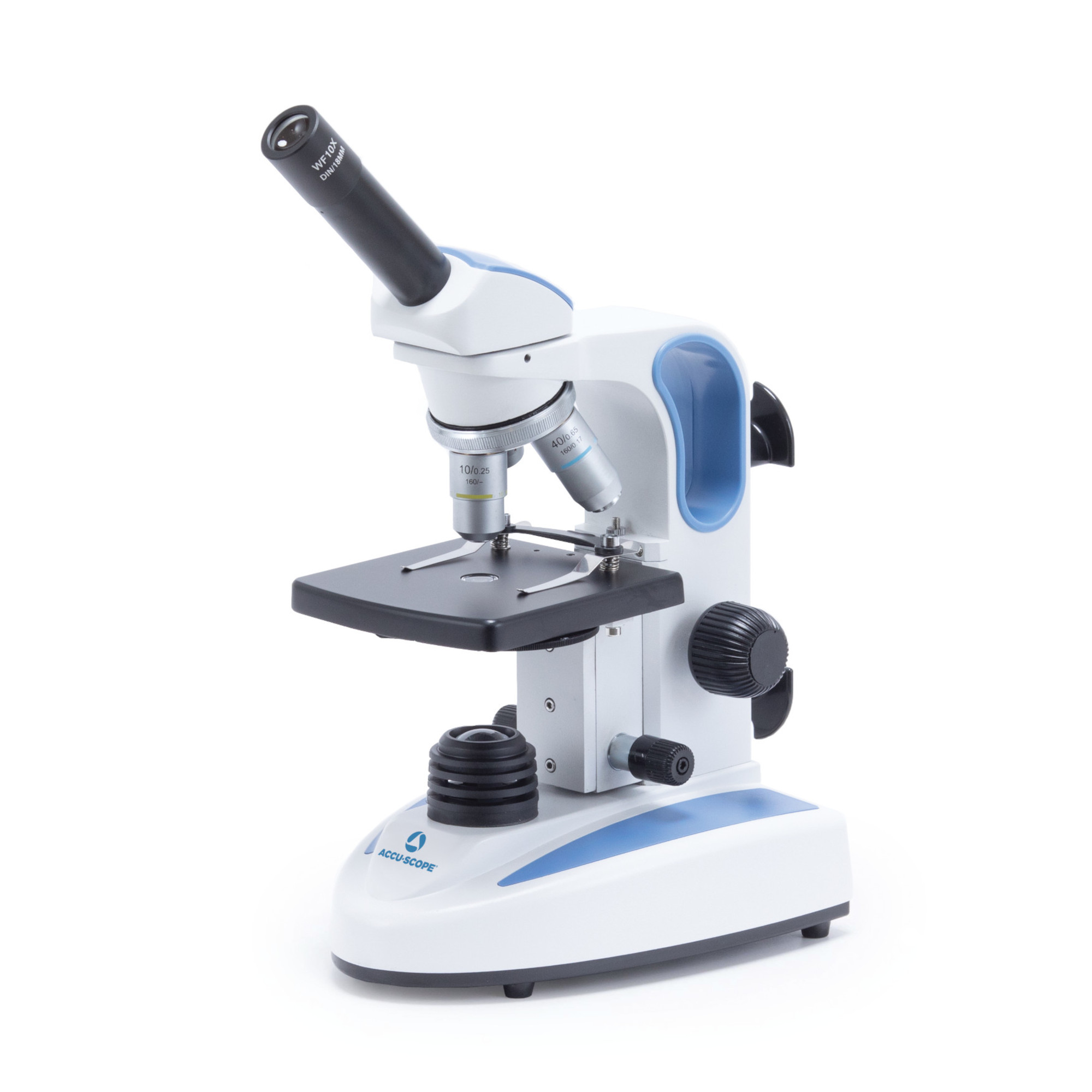
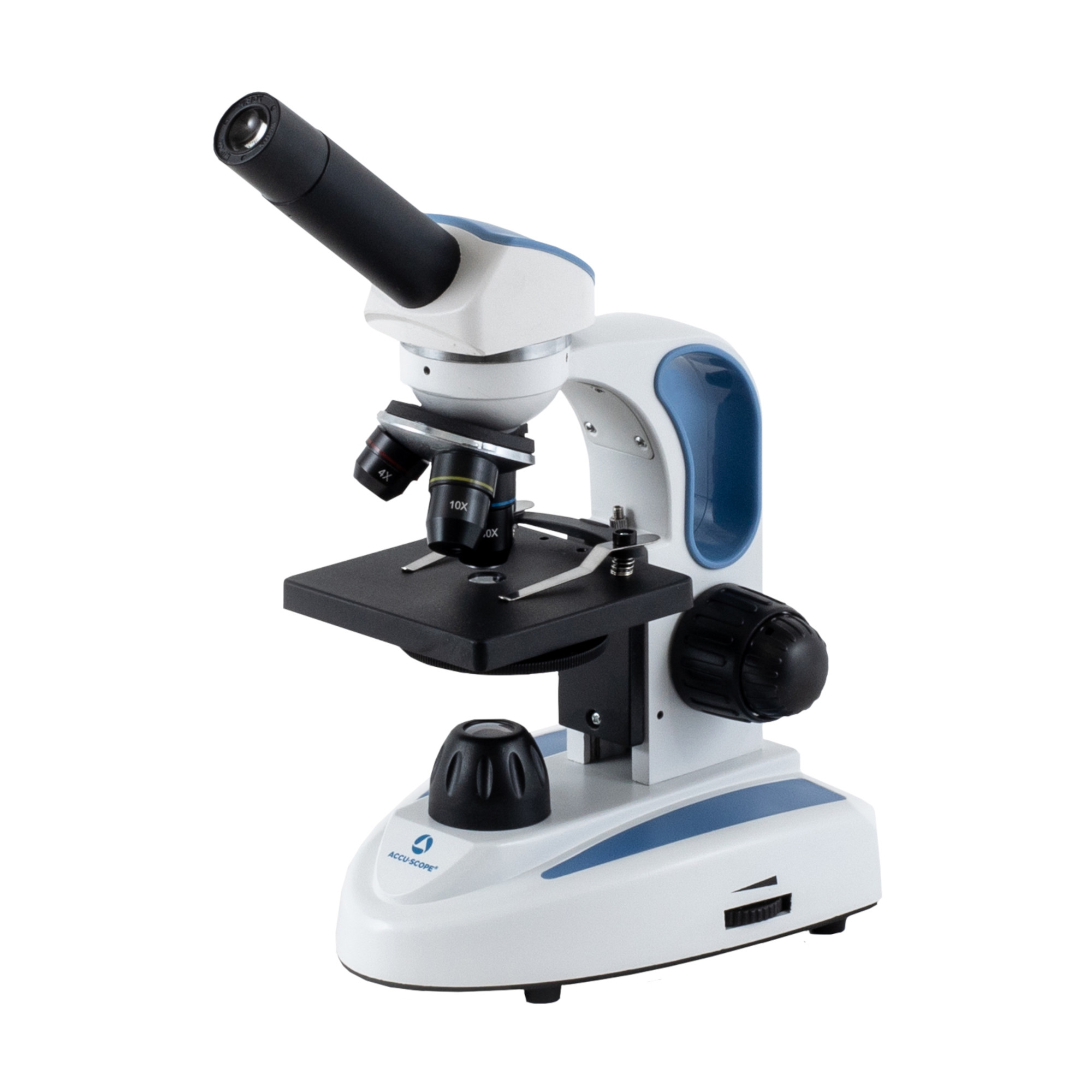
Monocular Microscopes

Perhaps the most iconic and recognizable types of microscope, monocular microscopes are compound microscopes distinguished by a single eye tube and eyepiece.  

 ACCU-SCOPE’s monocular microscopes are designed for dependable everyday observation in classrooms, laboratories, and other settings where straightforward operation and portability are priorities. They use high-quality optics for bright, crisp images and come with a standard selection of 4x, 10x, and 40x DIN objectives (“DIN”) is an international standard for thread type and focal length). Depending on the series, 60x dry or 100x oil immersion objectives are available. Many of our monocular microscopes are also available with digital cameras, making it easy to share, document, analyze, and present observations.  

 Browse our selection below, and contact us if you need help choosing the best monocular microscope for your application and budget.

EXM-150

The ACCU-SCOPE EXM-150 Series microscopes are easy to use and student-friendly.  Designed to provide educators with a high-performance,...
Learn More

EXM-50

The EXM-50 is a reliable and sturdy microscope, perfect for educational environments. Its compact design, built-in LED illumination, and carry handle...
Learn More

What to Look for in Monocular Microscopes

Choosing a microscope involves more than comparing a single specification. Optical quality, illumination, magnification, stage design, durability, and imaging requirements all affect how well the instrument fits its intended application.

Optical Quality and Objectives

Achromatic objectives are a practical choice for routine observation and education. They correct common chromatic aberrations to produce clear images with improved color accuracy across much of the field of view.

Plan-achromatic objectives provide additional correction so the image remains flatter (in focus) from the center toward the edges. This can be useful for photography, documentation, measurement, and applications where users need consistent detail across a larger portion of the field. If your work requires plan-achromatic optics, consider whether a more advanced upright microscope configuration is appropriate.

Read more

Illumination

Modern LED illumination offers long lamp life, low heat output, efficient energy use, and consistent light. Both the EXM-50 and EXM-150 use variable LED illumination, with cordless operation available for increased flexibility.

Halogen illumination is still found on some traditional and legacy microscopes and can provide smooth, warm illumination. However, LED systems generally require less maintenance and are especially convenient in classrooms and high-use environments.

Köhler illumination is another consideration for advanced microscopy. Proper Köhler illumination provides even specimen illumination while helping optimize resolution and contrast. Applications that require precise control of illumination may be better served by a higher-level laboratory microscope designed around this capability.

Read more

Magnification

Total magnification depends on the eyepiece and objective being used. A typical 10x eyepiece combined with 4x, 10x, and 40x objectives provides 40x, 100x, and 400x total magnification. Certain configurations can add a 100x oil-immersion objective for magnification up to 1000x.

Field number also matters when choosing eyepieces. A larger field number allows users to see a larger field of view and, therefore, a wider portion of the specimen at one time. For classroom work, a comfortable wide-field eyepiece can make it easier for students to locate specimens and maintain orientation as they increase magnification.

Read more

Stage, Focus, and Mechanics

A stable stage helps keep the specimen positioned as users move between areas of interest. Mechanical stages add controlled X-Y movement, which can be particularly helpful when scanning prepared slides systematically.

Coarse focus is designed to move the stage or optical system through a larger distance so the specimen can be brought into approximate focus quickly. Fine focus makes smaller adjustments for sharpening the image, particularly at higher magnification.

Features such as focus stops, tension adjustment, durable gearing, and spring-loaded objectives can also help protect slides and lenses in high-use settings.

Read more

Imaging Compatibility and Accessories

Digital imaging makes it possible to display, document, measure, and share microscope observations. Camera options may include eyepiece cameras that fit into the viewing tube as well as C-mount cameras used with compatible camera ports or trinocular microscope heads.

For example, compatible ACCU-CAM USB and Wi-Fi cameras can be used with select EXM-150 configurations. If routine imaging will be a major part of your workflow, consider a microscope with a dedicated camera port or a trinocular upgrade path so users can observe through the eyepieces while maintaining a separate imaging connection.

Read more

How to Choose the Right Monocular Microscope 

The right monocular microscope largely depends on its intended use.

For education purposes, prioritize straightforward controls, durable construction, LED illumination, locked or secured components, easy portability, and enough magnification for the curriculum. Cordless operation can also simplify classroom setup.

For clinical work, first determine whether a monocular configuration meets the laboratory’s workflow and regulatory requirements. Frequent professional observation generally benefits from binocular viewing, broader optical options, improved ergonomics, and, when needed, a dedicated camera port.

For industrial work, start with the specimen and inspection task. Thin prepared samples may work with compound microscopes, while larger three-dimensional parts, electronics, or assemblies are usually better suited to stereo microscopes.

Long-term support is another factor to consider. ACCU-SCOPE’s microscopes include a five-year limited warranty on microscopes and electronic components, with separate terms applying to LED lamps.

Browse Durable Monocular Microscopes from ACCU-SCOPE 

Browse ACCU-SCOPE’s monocular microscope collection to compare available models by application, optical configuration, magnification, illumination, and imaging requirements.

Schools and organizations purchasing microscopes in quantity can contact ACCU-SCOPE sales for bulk pricing, while laboratories and technical teams can request a tailored quote based on their workflow and performance requirements.

A selection of eyepieces, objectives, teaching accessories, and related components is also available. Compatible digital imaging solutions can further expand selected microscopes for documentation, instruction, and specimen sharing.

Frequently Asked Questions About Monocular Microscopes

Which Microscope Suits Classrooms Best?

The EXM-50 is a strong option for classrooms that need a simple, durable microscope with 4x, 10x, and 40x achromatic objectives, variable LED illumination, coarse and fine focus, and cordless operation. 

For programs requiring additional flexibility, consider the EXM-150 Series. Depending on the configuration, it can provide a mechanical stage, a 100x oil-immersion objective, rechargeable LED illumination, teaching heads, and digital imaging options. 

In either case, look for durable construction, intuitive focusing, LED illumination, protected optics, and easy storage.

A monocular microscope can be appropriate for some routine viewing and training applications, but clinical diagnostic laboratories often benefit from more advanced equipment. 

For extended professional use, consider upgrading to a binocular or trinocular microscope with appropriate objective lenses, improved ergonomics, mechanical stage controls, and imaging capability. ACCU-SCOPE’s EXC-120 Series, for example, includes configurations designed for clinical as well as classroom applications.

The connection depends on the microscope and camera. Typically, the camera will replace the standard eyepiece and requires an adapter that connects to the camera on one end, with the other end sliding into the eyetube of the microscope. Other cameras may have the adapter built into them for easy installation. 

Since monocular microscopes are generally small, smaller and lighter cameras are recommended. The EXM-150, for example, supports compatible USB, Wi-Fi or eyepiece cameras. 

A typical setup involves removing or accessing the appropriate eyepiece or camera port, installing the compatible adapter if required, attaching the camera, connecting it to the computer, monitor, or mobile device, and then adjusting focus and software settings. 

A monocular microscope uses one eyepiece, while a binocular microscope allows observation with both eyes. Monocular designs are typically simple, portable, and economical, making them particularly practical for classrooms, field work and occasional use.

Binocular viewing can provide better ergonomics during long microscopy sessions because users can observe with both eyes. It is therefore commonly preferred in professional laboratories.