

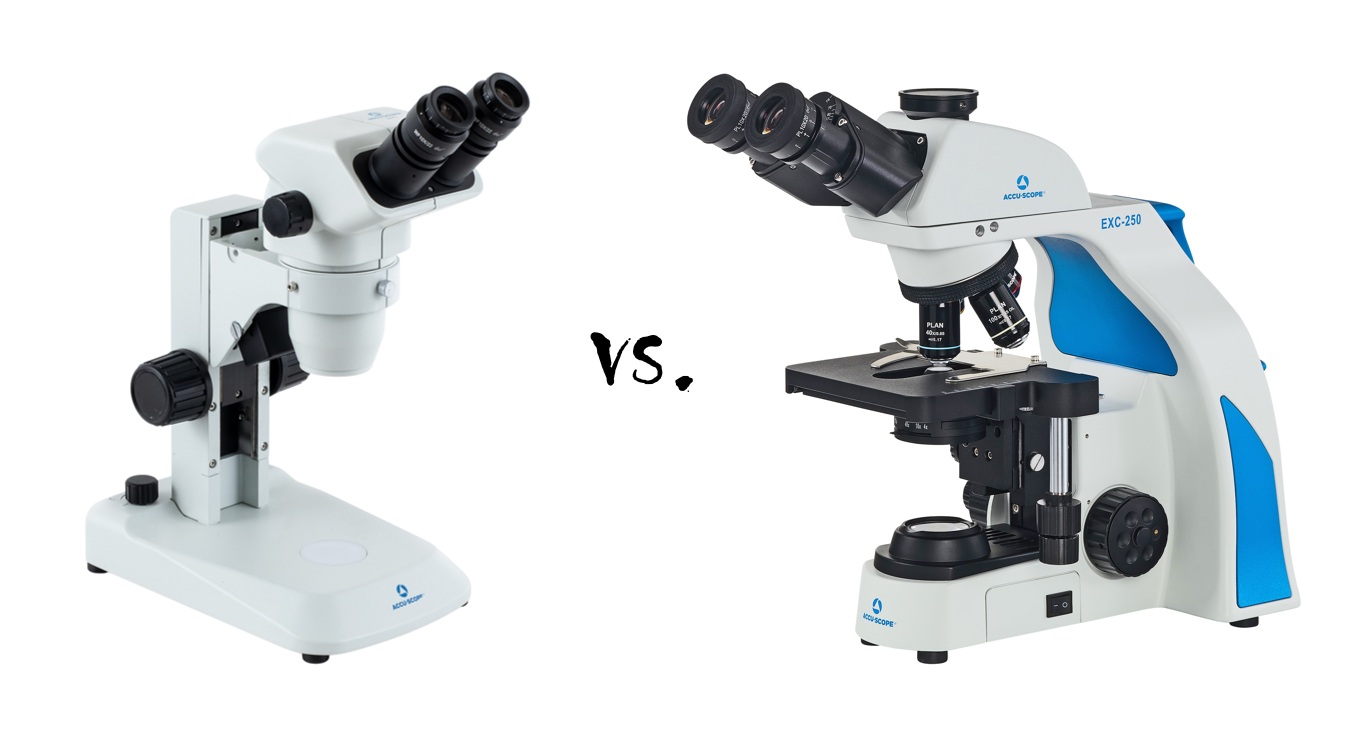
Choosing between a dissecting microscope and a compound microscope depends on the specimens you need to examine and the level of detail your work requires.
A dissecting microscope is generally better suited for examining larger, three-dimensional specimens, while a compound microscope is designed for viewing smaller structures within thin specimens.
For biological dissection, electronics inspection, and surface examination, a dissecting microscope is often the preferred choice. Laboratory professionals studying cells or microorganisms typically benefit from the higher magnification of a compound microscope.
This comparison will define each microscope before exploring the differences in optical design, magnification, and working distance.
What Is a Dissecting Microscope?
A dissecting microscope is a low-power optical instrument that provides a three-dimensional view of a specimen. Also known as a stereo microscope, it allows users to examine larger objects without requiring extensive sample preparation.
Dissecting microscopes are particularly useful for observing solid specimens, including insects, plant structures, and industrial components. Their optical configuration makes it easier to manipulate objects while maintaining a clear view.
What Is a Compound Microscope?
A compound microscope is an optical instrument designed to examine small structures at relatively high magnification.
Most conventional compound microscopes use transmitted light, which passes through thin specimens mounted on glass slides. Multiple objective lenses allow users to examine specimens at different magnification levels.
These microscopes are widely used in clinical laboratories, biological research, and educational settings to study cells, tissues, and microorganisms.
Unlike stereo microscopes, conventional compound microscopes typically produce a two-dimensional image with limited depth perception.
Dissecting Microscope vs. Compound Microscope at a Glance
The primary differences between these microscope types include:
- Specimen type: Dissecting microscopes accommodate larger, often opaque specimens. Compound microscopes typically examine thin, transparent samples.
- Magnification: Dissecting microscopes generally operate at lower magnifications, while compound microscopes provide substantially higher magnifications.
- Working distance: Dissecting microscopes offer more space for specimen manipulation. Compound microscopes generally have shorter working distances, especially at higher magnifications.
- Image depth: Dissecting microscopes provide stereoscopic depth perception (3-dimensional). Conventional compound microscopes produce flat (2-dimensional) images.
Optical Design and Objective Lenses
One of the most significant differences between these instruments involves how their optical systems form images.
Stereo microscopes use separate viewing paths to produce depth perception. Depending on the configuration, they may feature fixed-magnification optics or adjustable zoom systems.
A compound microscope uses an objective lens to produce a magnified image that is viewed through an eyepiece. Most compound microscopes have multiple objectives mounted on a rotating nosepiece, allowing users to change magnification.
Illumination also differs. Stereo microscopes commonly use reflected light to illuminate specimen surfaces from above, but episcopic (transmitted) illumination may be used for translucent samples. Conventional compound microscopes primarily use transmitted light to reveal internal details in transparent specimens.
Magnification Capabilities
A major consideration between a dissecting microscope and a compound microscope is magnification.
Typical stereo microscopes provide approximately 10x to 40x magnification, although available ranges vary by model and configuration.
Compound microscopes commonly offer magnifications ranging from 40x to 1000x. Higher magnifications make it possible to examine cellular structures that cannot be resolved with standard stereo microscopes.
However, greater magnification does not automatically produce better results. Optical resolution determines how much detail a microscope can be distinguished. Excessive magnification without sufficient resolution simply enlarges the image without revealing additional information.
Field of View
Field of view describes the area of a specimen visible through the microscope.
At comparable magnifications, field of view depends on the microscope’s optical configuration. However, dissecting microscopes are generally designed to provide broad viewing areas at low magnification.
As magnification increases, the visible specimen area becomes smaller.
Working Distance
Working distance is equally important. Stereo microscopes typically offer generous clearance beneath the objective lens, making them suitable for tasks requiring hands-on manipulation.
Compound microscopes have less clearance, particularly when using high-power objectives that must be positioned close to the specimen.
Sample Preparation and Illumination Requirements
Dissecting microscopes generally require minimal specimen preparation. Users can place whole insects, plant samples, or manufactured components beneath the objective and begin examining their surfaces.
Reflected illumination helps reveal textures and other visible features on opaque objects.
Compound microscopy often involves additional preparation. Biological specimens may need to be sectioned, mounted on slides, and stained to enhance contrast.
Transmitted illumination passes through sufficiently thin specimens, allowing users to observe internal structures that would otherwise remain difficult to distinguish.
Applications for Biology and Laboratory Work
For biological dissection, stereo microscopes provide important advantages. Their three-dimensional viewing capability helps researchers identify anatomical structures while using instruments to separate or manipulate tissues.
Compound microscopes are more appropriate for examining cells, tissue sections, and microorganisms that require greater magnification.
Teaching laboratories may benefit from having both microscope types available. Students can use dissecting microscopes to examine larger biological structures before switching to compound microscopes for cellular observations.
Applications for Industrial Quality Control
Microscopes also play an important role in industrial inspection.
Stereo microscopes are commonly used to examine electronic assemblies, solder joints, and manufactured surfaces. Their depth perception helps technicians identify visible irregularities, while extended working distances make it easier to position and manipulate component.
Compound microscopes may be appropriate for examining microscopic material defects, particularly in thin sections or specially prepared samples.
Digital imaging capabilities can benefit either instrument. Compatible microscope cameras allow technicians to capture inspection images, document findings, and maintain visual records for quality-control purposes.
Choosing Between Dissecting Microscopes and Compound Microscopes
Selecting the appropriate microscope begins with understanding your specimens and inspection requirements.
Consider specimen thickness and whether light must pass through the material. Larger, opaque objects generally favor stereo microscopy, while thin specimens requiring cellular-level examination often favor compound microscopy.
Next, determine the magnification and resolution needed to observe the relevant features.
Depth perception is another important consideration, particularly when working with tools or inspecting uneven surfaces.
Finally, evaluate digital imaging requirements. Laboratories that need documentation or image sharing should consider camera compatibility and available imaging software.
ACCU-SCOPE offers professional dissecting microscopes and upright compound microscopes for different laboratory and inspection applications.
Frequently Asked Questions
Is a Stereo Microscope the Same as a Dissecting Microscope?
Yes. A dissecting microscope is a type of stereo microscope. The term “dissecting microscope” emphasizes its use in dissection and specimen manipulation, while “stereo microscope” refers to its optical design and three-dimensional viewing capability.
Which Microscope Provides Higher Magnification?
Compound microscopes generally provide higher magnification than stereo microscopes. Conventional compound systems may reach 1000x, while standard stereo microscopes typically operate at much lower magnifications.
Although stereo microscopes have lower magnification ranges, their wider viewing areas and greater working distances make them better suited for many surface inspection tasks.
Which Microscope Is Better for Quality Control?
The best microscope depends on the components and defects being examined.
Stereo microscopes are generally preferred for three-dimensional inspection of electronic assemblies and other manufactured components. Their depth perception helps operators identify surface irregularities.
Compound microscopes are more appropriate for detecting microscopic defects in thin or prepared materials.
Evaluating specimen characteristics and inspection requirements helps ensure the selected microscope delivers useful information without unnecessary magnification.